What It Really Means to Be a Photographer
People love to say, “Wow, that’s a great photo, you must have a nice camera.” It’s usually meant as a compliment, but every photographer knows that line misses the point entirely.
Because being a photographer has never been about just having the gear or knowing how
to press a shutter. A camera is just a tool. And pressing a button? That’s the easiest part.
It takes one tenth of a second. But what leads up to that moment, and everything
that comes after, is where the real work happens.
Telling a photographer they must have a great camera is like walking into a master carpenter’s workshop, running your hand along a flawless handcrafted table, and saying, “You must have a really nice saw.” Sure, they probably do. But the saw didn’t design the piece, choose the wood, make the joints invisible, or sand every curve by hand. The camera, like the saw, is just a tool. It’s not what creates the vision. The craft, the experience, the instinct, that’s all human.
Before that button is ever touched, a photographer is already building the shot. Mentally constructing the scene. Choosing a lens not just for focal length, but for distortion, compression, mood. Deciding whether the story needs shallow depth of field or tack sharp depth throughout. Figuring out whether to freeze motion or embrace blur. Thinking through shutter speed, ISO, white balance, and how they all work together under the lighting conditions at hand.
Then come the lights.
Natural light, strobes, constant lights, reflectors, scrims, gels. Where do you place them? What modifier creates the right kind of contrast? Do you want soft shadows or harsh edges? One light or three? Do you want separation from the background, or do you want the subject to blend into it?
Then there’s composition,
the unspoken grammar of visual language. Lines, curves, balance, tension. Negative space. Subject isolation. Foreground and background relationships. And that’s all before you even look through the viewfinder.
When you finally raise the camera to your eye, the world slows down. You become hyper aware of every detail. The way the light hits the skin. The expression in the eyes. The shape of the jawline from this angle versus that one. The direction of the wind in the hair. The tension in a pose. You're also watching for something deeper; Coaxing a smile out of someone who doesn't like to smile. and helping someone who feels self-conscious about their smile to frame their face, so they are not smiling but still look beautiful. You’re waiting for that fraction of a second when everything lines up just right, when the subject feels something, and you feel it, too. That’s the moment you press the shutter. Not before. Not after. And then, after all that, you’re still only halfway there.
Now you step into post. And this is where real skill comes in. Editing is where good photographers become great. You dodge, you burn, you retouch, you color grade. You bring depth to shadows and light to the eyes. You remove distractions, correct for lens distortion, fix color casts. You decide what the photo feels like, cool and cinematic, or warm and nostalgic. You fine tune skin tones down to the slightest hue. You sharpen what matters and soften what doesn’t. You choose where the viewer’s eye should land first, and how it should travel through the frame.
You can spend 10 minutes on an edit or 10 hours.
Some images need precision. Others need restraint.
Either way, you’re sculpting, not just pixels, but emotion.
Being a photographer means carrying the weight of intention in every shot. It’s studying light like a physicist and movement like a dancer. It’s having the patience of a hunter and the intuition of a storyteller. It’s knowing how to make someone feel safe, strong, powerful, or vulnerable, and capturing that in a single frame. It’s not just showing what someone looks like. It’s showing who they are, or who they could be, or even what the world might miss if no one slows down to look. Photography is part science, part psychology, part art, part grit. It’s not easy. But it’s worth it.
So no, we don’t just “press a button.”
We make decisions. We solve problems.
We craft light. We create mood.
We tell stories.
And if we do it well,
you’ll feel it.


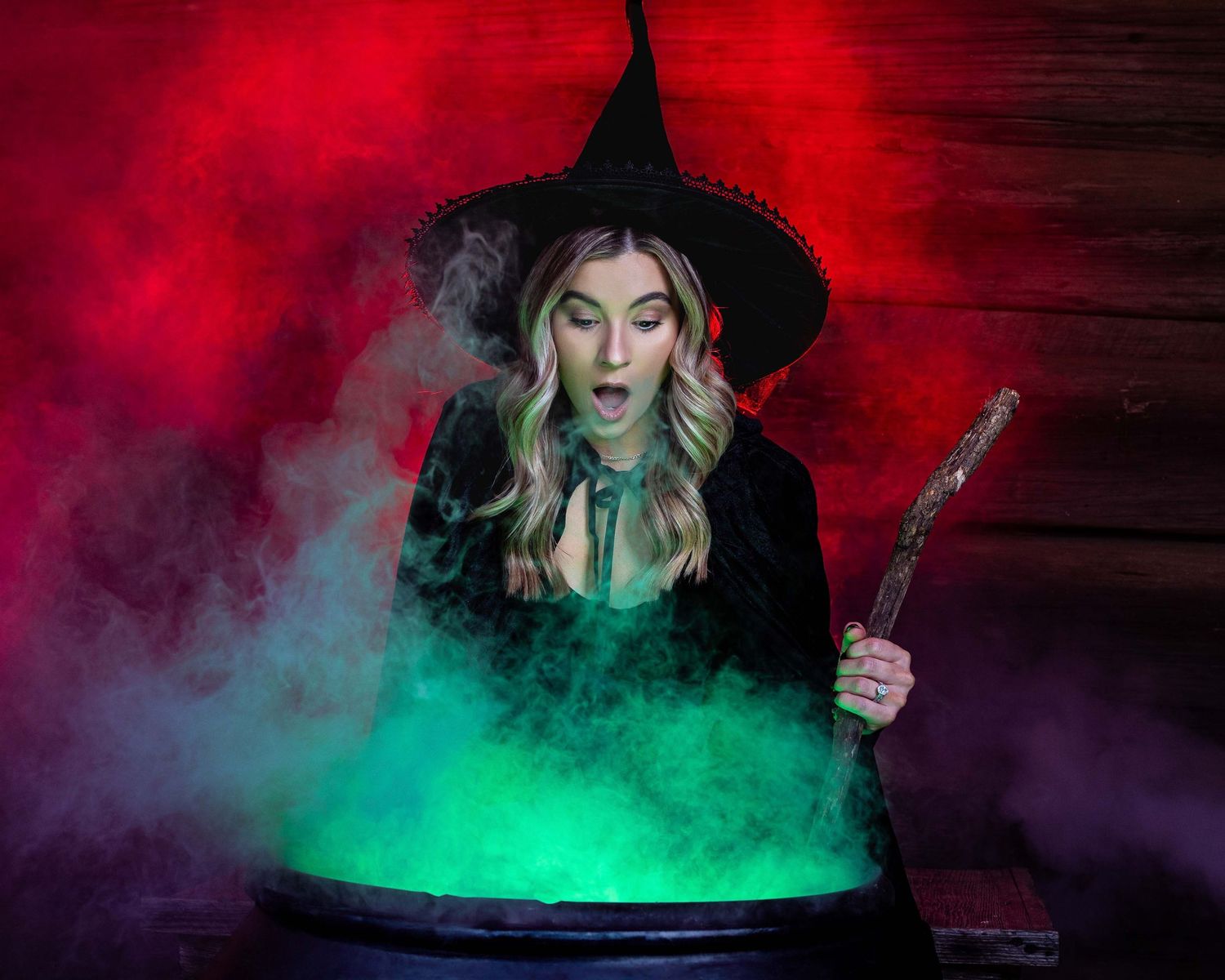
These images weren’t taken at midnight under a full moon, but in daylight, two in the afternoon on a partly cloudy day, on the porch of a log cabin near my hometown. There was no magic, just light. No spell, just settings. The only shade came from the porch itself. The drama you see here comes entirely from understanding how to control light, both ambient and flash, and knowing how to make a camera see what your mind envisions. This is what photography really is, more than just pressing a button. Anyone can press a button, but shaping light, creating atmosphere, and telling a story takes skill, vision, and intention.
And of course, this is Kayla, my daughter. Beautiful, accomplished, and somehow managing to make even a witch’s hat look elegant. Watching her bring this character to life reminded me why I love what I do, photography lets me capture not just what people look like, but who they are, and sometimes, who they dream of being.
Follow me on Instagram


